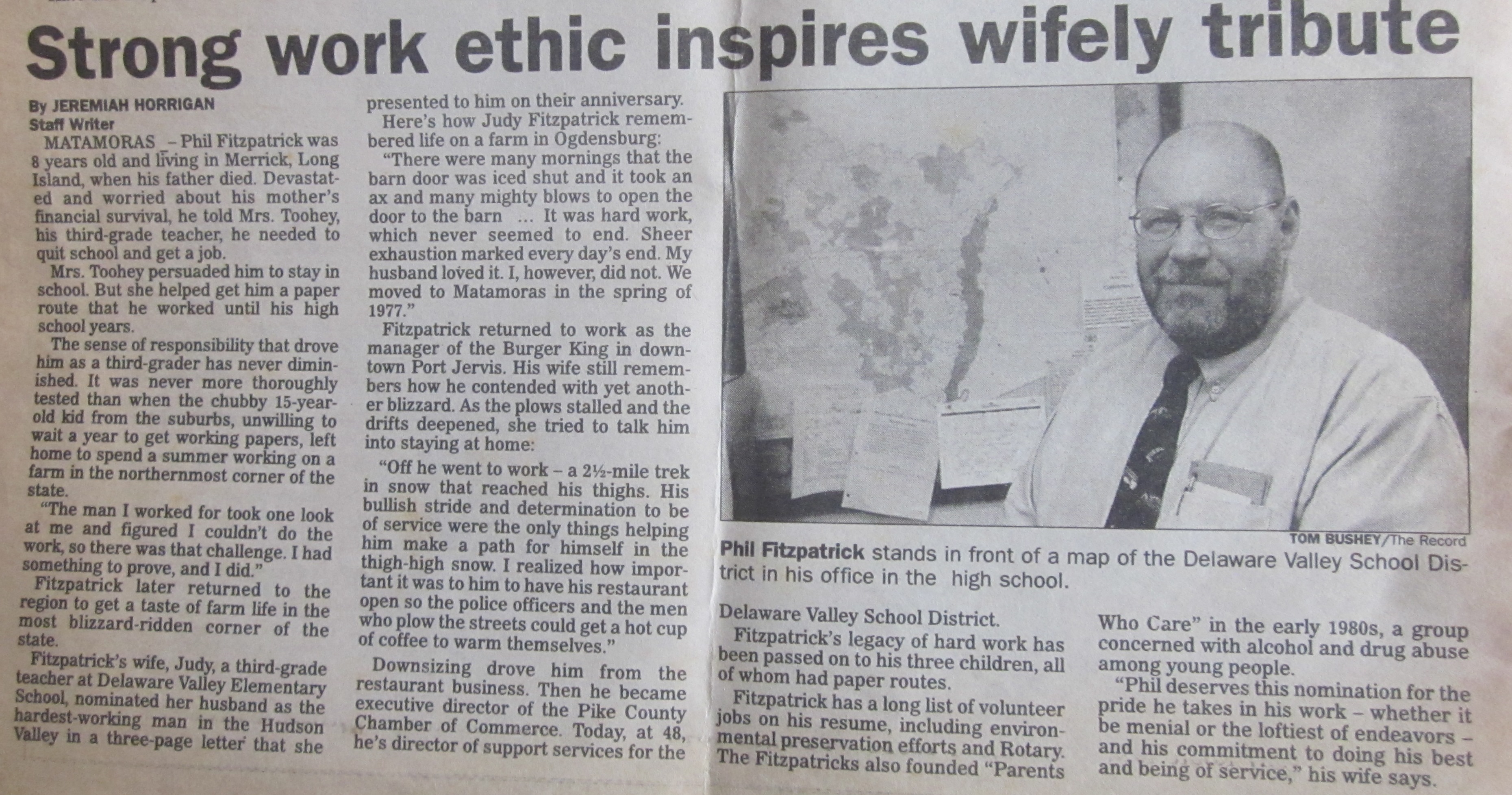
He was eight years old and in the third grade. He remembered having breakfast with his dad after his father had gone to daily mass. His dad took the train to work each morning and moonlighted as a cabby at night. He was always tired and the boy rarely saw him, so having breakfast with his dad was a special treat.
It was April Fool’s Day, 1958. At first, the boy thought it was a cruel trick that someone was playing on him, but it wasn’t a trick. His father never came home that night.
The boy’s mother didn’t want her children to go to the funeral home, but some of the aunts and uncles got to him anyway. “You are the man of the house now,” they said. “You must take care of your mother.” At that very moment, the boy’s childhood was lost to him. Now he needed to be responsible. He needed to work. He felt like his family’s financial survival depended upon him.
The day his father was buried, the young boy walked into the principal’s office and told him that he needed to quit school and get a job. The principal was a very wise man and treated the child like the adult he was trying to become.
“Will you consider staying if I can get you a job after school?” the principal asked. The boy nodded. He arranged for the boy to have a paper route–120 papers to be delivered before dinner every day. The boy rode his bicycle to every house, and he gave his mother every penny he earned.
His sense of responsibility never diminished. He always found a job even when others could not, and he never slacked off. At fifteen, he was too young for working papers, but that didn’t stop him. He signed up for the farm cadet program. Working papers weren’t required for farm work.
He was sent to a farm in Hammond, New York, ten miles from the Canadian border. The farmer looked at the chubby boy from Long Island and was instantly disappointed. Surely this portly teenager could not possibly be able to do the physical work required to run a farm, and he told the boy as much. “This work isn’t for everybody. There’s no shame in leaving,” he told the boy. It was as if a gauntlet had been thrown; he silently accepted the challenge. There was no way he was quitting. That was the summer the hay bales were packed so tightly in the barn that it was difficult for the farmer to get them loose that winter. Never had the farmer hired a stronger or more relentless worker.
The boy grew up, married, and became a father of three children before his twenty-seventh birthday. Like his own father, he worked two jobs to support his family—managing a fast food business by day and working with a plumber at night. Just like the boy he once was, his own children saw their father only for a brief time at the dinner table each night.
His dedication to serve was never more evident than in the winter of 1978 when blizzard conditions stalled the municipal plows and the snow drifts deepened, covering cars and fences. His wife tried to persuade him to stay home.
“No one will be out. The plows haven’t even come through. How will you get to work?” she pleaded. She worried that a three-mile walk down country roads at four in the morning could be dangerous, but he would not be dissuaded. She watched him walk down the long driveway to the road, pushing through the thigh-high snow with his powerful legs. His bullish determination and brute strength pushed him forward as he plowed through the snow with each stride. He could not stay home. He needed to open his restaurant to offer hot coffee and breakfast to the police officers who were on-duty and the men who plowed the streets.
As a young man, he preferred physical labor. Over time he had worked with an electrician, a landscaper, a plumber, and a mason. He worked in a lumberyard, a church, a gas station, and an ice cream shop. The very last job he ever had was really five jobs rolled into one. It was too much for any one person to do, but he did not give up and would not complain. His wife was concerned for his health. “This job is going to kill you,” she once told him in exasperation. She meant it to be a shocking statement. Maybe it would convince him to go to his boss and finally ask for help. But he had never encountered a job that he could not do. He was proud, so he worked all the harder.
Like all the other work he had ever done, he gave that last impossible job his all. In the end, it took more than he had to give. After he died, they hired three people to take his place.
Labor Day. It is the day I think of that little boy and the man he ultimately became. I honor his memory. He was the hardest-working person I have ever known. He was my husband.
Labor Day. A time set aside to honor those who work—men and women who sweat to make a living, men and women whose occupations require bodily strength, intellect, or a combination of both, men and women who labor and sacrifice for the good of their families, their communities, and our nation.
Labor Day. A time to be thankful for the labors of our neighbors, our friends, and our family. A time to honor those who came before us and acknowledge their contributions. A time to say “thanks” to the hardest -working people we know.
 Little by Little in the Blink of an Eye
A beautiful tribute to a man that was obviously loved by many and mostly by his wife!
LikeLike