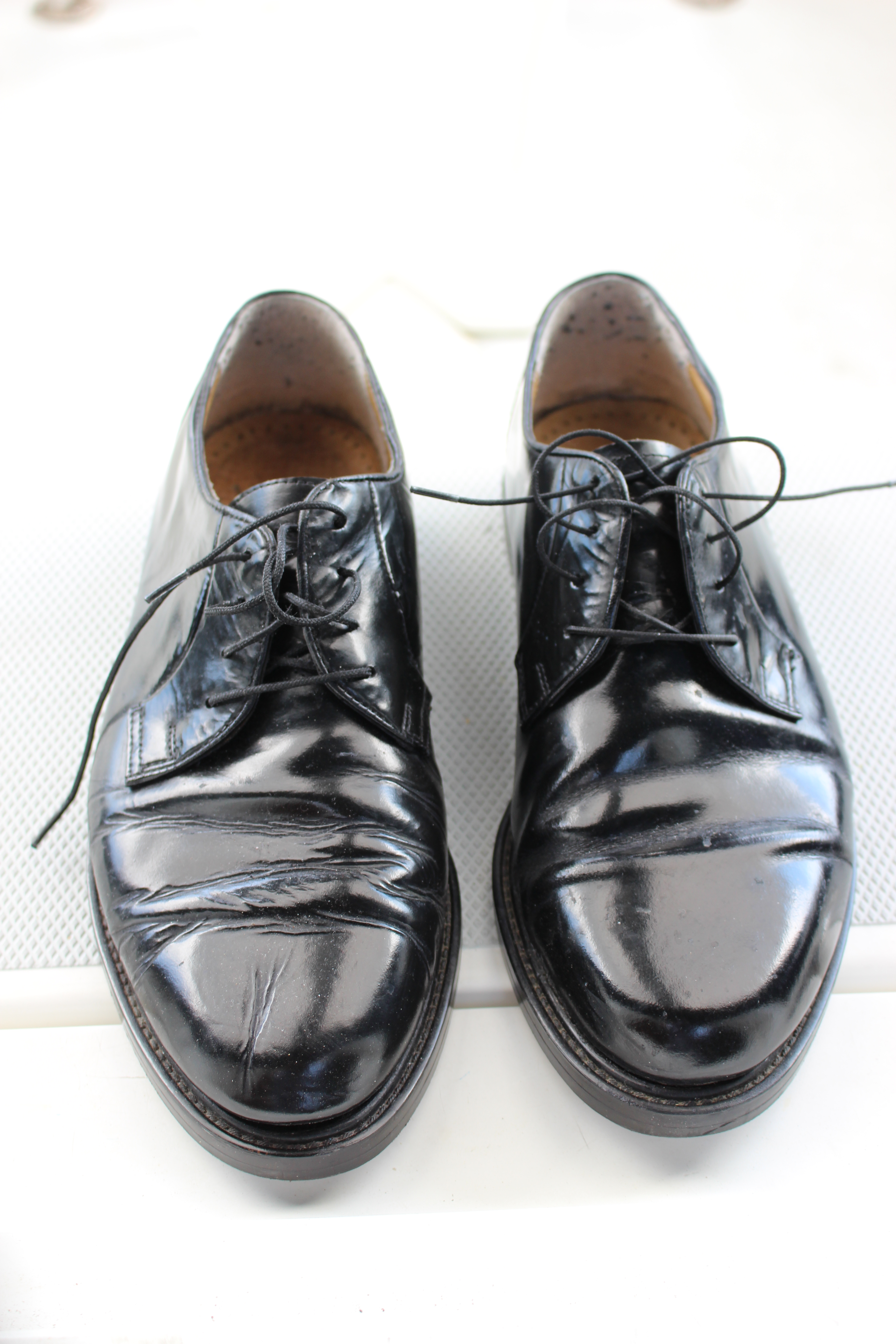
I have no idea why I lied to the shoemaker. When I did it, I was instantly horrified by my inability to tell him the truth. It’s been almost two years since I lied to him, and it still sticks with me and makes me feel like a fraud. Maybe I can’t let it go because, now, there’s no way to make it right anymore.
Maybe the shoemaker would have understood, but maybe not. He was a kind, gentle man and he really liked my husband. Every time I went into his shop, he spoke of my husband and how friendly he was to him. My husband’s kindness to him meant so much to the shoemaker. He made that abundantly clear each time I went into his shop. Sometimes I had to fight really hard to hold back my tears.
When I walked through the door of the shoemaker’s shop, a buzzer rang in the back of the store, signaling a customer. As I turned over my sack, black wing tips–sized 10 ½– tumbled out and rested on their sides on the front counter of the dimly-lit shop.
“These need new heels,” I said. I realized that I hadn’t even said hello to him. I hadn’t even thought to exchange the pleasantries that my husband would have exchanged with him. The old man didn’t seem to notice as he picked up each shoe, inspecting the bottoms of them.
“Unt soles,” he added. “You see vere the stitches are vorn?” I looked closely to where he pointed. “Soon they vill rip, yes?” I nodded.
In the twenty years since I had first met the shoemaker, neither his face nor his charming Austrian accent had changed very much. He seemed eternally youthful and always kind. Only the color of his hair had changed over the years. It had been dark brown; now it was the color of steel.
“Unt whose shoes are these?”
He knew they couldn’t possibly belong to my husband. My husband had died suddenly almost ten years before. He tilted his head forward, eyebrows raised, and peered over the tops of his eyeglasses looking me straight in the eye. I froze.
“My son’s. These shoes are my son’s shoes.”
“Ah, your son’s,” he answered almost wistfully.
Immediately I felt foolish and cruel—foolish for the lie and cruel as I remembered that this old man had lost his own son years before in a terrible accident. His son had been a brilliant and talented young man and his future had been ripped from him one night by a local drunk driver with a record of DWI’s.
Had I triggered renewed sorrow in the old shoemaker by mentioning my own son? I searched his eyes for any possible flicker of pain and was relieved that his expression had not changed.
“Have you been fishing lately?” I asked a little too brightly. He, like my husband, was a fly fisherman. As he always did, he worked his answer around what he really wanted to say—what he said each time I came into the shop. He told me, once again, what a fine man my husband was.
“You know, some people hear my accent and turn avay, like I am not verth speaking to. Your husband vas alvays kind to me. We had many fine conversations. You must miss him.”
“Yes, I do miss him. Everyday. He was a very fine man,” I said before the lump gathering within my throat made it impossible to answer.
As I walked out of the shop and into the morning sunlight I realized that everything I had told the shoemaker was the truth—Everything. Except the part about whose shoes those really were.
 Little by Little in the Blink of an Eye
Wonderful story…brought tears to my eyes….
LikeLike