Children Always Know

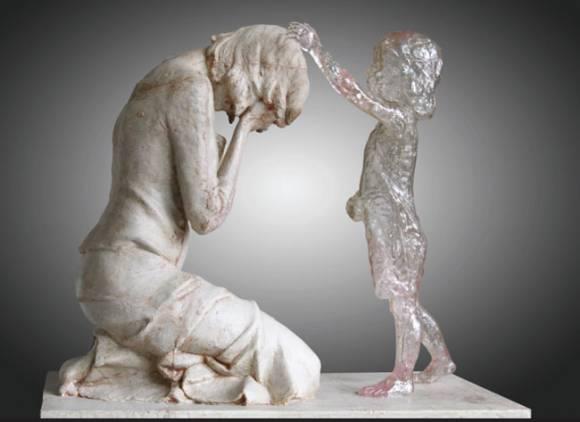
grieving mother sculpture

Children always know when something is wrong.   Adults may think they are shielding them from grief, anguish, and sorrow, but children take it all in and feel it anyway.  If adults aren’t square with them, if they don’t acknowledge their own feelings and level with their children, their little minds will fill in the blanks, making them fearful and anxious in the absence of hard facts. 

There was a time when people thought children could not possibly feel the sorrow that adults feel.  Conventional wisdom led those adults to believe that it was best to leave children out of the grief process, to spare them as if sorrow could not possibly concern them.  It doesn’t matter whether this attitude was born of ignorance or expediency; the result was the same–for the children who felt the sorrow but didn’t understand what was causing it, it was like being dropped off on a strange street corner far from home in the middle of the night.  Alone.  Emotionally abandoned.  

You may wonder how I know all this.  I learned it firsthand.

The birth of my first sibling took me by surprise.  I have no memory of having noticed my mother’s rounding belly, signaling my brother’s impending birth.  It wasn’t pointed out to me or discussed in front of me.  I don’t remember any gleeful adult chatter about the prospect of becoming a big sister.  No one asked me if I wanted a little brother or a little sister. I was only three then, and it was the early 1950’s–a time of emotional restraint, a time when children were still expected to be seen and not heard—a time when a woman did not announce her condition until well after the first trimester, when her belly could speak the words for her.

No one used the word “pregnant” in polite company back then and to this day, the very word sounds crude to my ears.  It was, instead, referred to as a “blessed event” or “being in the family way.”  It was certainly considered inappropriate to speak about such things in front of children and so when my brother was born in early November, 1953, it was quite literally as if he had magically appeared and was brought home to live with us.

My mother had been taken to Mercy Hospital in the middle of the night to have her third child in the Spring of 1956. I was six years old by this time and I remember being wildly excited for the possibility of a baby sister, chatting merrily and excessively about the baby, asking my grandmother when mommy and the new baby would come home.  The more my questions were left unanswered, the more insistently I asked them.

But something wasn’t quite right.

My daddy, usually so sunny and animated, seemed sad and distant.   It was impossible for me to know what was wrong, but I felt his sadness and it scared me.  I tried to make him laugh.  The best I could draw from him was a weak smile. The adults spoke together in hushed, closed circles.  I couldn’t hear their actual words, just their somber tones.  A sense of dread settled deep within my stomach.

I was sent to my cousins’ house after school.  I had never been sent there before and my stomach ache grew worse.   Even though they lived in the same neighborhood, I felt like I was being banished to a foreign land.  Although they were my second-cousins and they lived around the corner, I never went there to play.  Only now can I admit that I never really felt comfortable around them.  I never really liked them.

There was a lot of drama and yelling in my cousins’ household—lots of teasing, complaining, tattling, yelling.  I didn’t want to be around people who yelled.  I wanted to go home where things were calm and predictable, but the dread that filled my belly warned me that there was a good chance that place didn’t exist anymore.

The girls on their street played different games than we played on my block.  One of the games involved laying on our backs in the grass and looking up at the clouds to see what shapes emerged. When we saw a shape, we were supposed to call it out.  I remember stretching out on the front lawn with them and dutifully looking up, but I didn’t want to look at the clouds.  I just wanted to go home.  A terrible headache blurred my eyes and my stomach was filled with dread.  I just wanted to be home in my own bed, so I got up and began to walk away.  I was half way home before they chased me down and brought me back.

Dinner felt strange at their house.  They sprinkled sugar on their tomato slices rather than salt.  I so desperately wanted to go home where things made sense.  Putting sugar on tomatoes made no sense to me.  To this day I remember those tomatoes and how strange and unwelcoming it felt to sit at their dinner table.  I felt trapped and vowed never to go back there ever again.

The next day my grandma arrived and I was able to sleep in my own bed.  My mother and father were still suspiciously absent, but I felt grateful to be in my own home with my grandma.  I played with my own friends on my own block and my stomach stopped hurting for a while. I began to relax until I caught the words of our neighbor who came to speak to my grandma over the split rail fence as she hung the wash on the clothesline.

My neighbor spoke in hushed tones, but just loud enough for me to hear.  Impossible words tumbled from her lips, “I am so sorry.”

My mommy and my new baby sister were due to come home the next afternoon.  It was decided that I should be allowed to stay home from school to welcome them.  I remember being in the bathroom that morning, ecstatically brushing my teeth when my grandma came in.  She spoke in a solid, authoritative voice, giving me no hint of what was to come.

“Mommy is coming home today, but she won’t be bringing home the baby.  The baby died.”  I dropped my toothbrush and burst into messy, gulping, howling tears.  My grandma continued as best as she could.  I remember the hitch in her voice as she spoke.

“Now stop crying and wash your face.  You need to be a good girl for your mother.  She is very sad.”

I tried to be a good girl.  I tried to be helpful and cooperative and quiet, but I was only six.  Years later I suffered from depression, and in therapy I learned that unresolved childhood grief can result in depression later in life.

I was not encouraged to cry for my baby sister or talk about her and in all the years after her death, we rarely spoke her name.   A nurse had hastily baptized her before she took her last breath, christening her with the name Bernadette.  Her name, so unlike any name our parents would have chosen, was the only proof that she had ever existed.

Bernadette.  My confirmation name.

Bernadette.  The middle name my parents chose for my second baby sister—the one who did come home with mommy two years later.

Bernadette. After sixty years, I can still feel the dread of not knowing. And I still cry for you.


Of Slow-Motion Magic and Bent-Kneed Miracles

2015-10-17 Hidden miracles of Autumn 004

Autumn trees are magicians.  They work slow-motion magic in the silence of October nights as darkness wrestles minutes from each day.  Preordained frost becomes their magic wand, turning weary leaves crimson, russet, persimmon, scarlet, gold.

Summer’s steady, stalwart green transforms against its will, becoming showy flash and fiery glow.  Sweatered seekers roam rural roadsides for Autumn’s treasure–apples, cornstalks, pumpkins, cider, pots of mums, and flowering kale. But Autumn’s magic does not end with these alone.

There is so much more to see.

There are humbler miracles–low to the ground–easy to miss in deep Fall.  Stealthy chill fingers turn flower stems dry and leaves to mottled gray.  As their little lives ebb, they crumble and bend under the weight of crisp seed pods which crack and open in the sun, releasing tiny promises to the ground below.

In deep Fall the once pert and perfect gardens of Summer become wizened tangles of naked stalks and fallen leaves and bowed brown flower heads.   Upon a closer, bent-kneed look, good fortune may show you a final bloom—small, vibrant, perfect–a final gift before the frost.  These tiny gifts sit still and wait for keener eyes to see.  They are the magical ones—the ones who have summoned their waning energy for one last chance to blossom, giving us a final gasp of beauty before the hard frost.

What Do You Believe Is True?

2015-08-12 camera download 8.22.15 008

I tried to remember the exact wording to the answers to all those questions in my Baltimore Catechism, I really did.   We were expected to have all our answers memorized in order to receive our First Holy Communion.  When it came right down to it, I chose to answer the questions in my own words when it was my time to be quizzed by our parish priest.  He frowned and his fountain pen hovered over my name; he was ready to cross me off his list.

“She’s not ready,” the priest told my mother and the Josephite nun who happened to be my catechism teacher.  My mother was deeply embarrassed for me and for herself.  She had been the one who sat with me after dinner every night, going over and over the required questions and their exact answers in preparation for this moment.  She could have told the priest that I really did know the answers, that we had studied faithfully each night, that I tended to answer with my own words, but she couldn’t find her voice.

“Begging your pardon, Father…” began the nun.  She proceeded to speak on my behalf–quite a bold thing for a nun to do in 1956.  Priests always had the last word back then and it was a nun’s duty to obey.  I received my First Holy Communion with all the other squirmy six-year-olds in my class that Spring.  So began my bumpy relationship with a god I wasn’t particularly fond of.

The catechism was eventually put aside, but the questions kept coming.  The answers were elusive and unsatisfying.

If God was All-loving and forgiving, how could he condemn any of His people to eternal separation from Him?  If He had given us free will–the ability to make choices for ourselves–why had religion become so rigid and fearful of change? Why was it so wrong of Eve to want the knowledge of good and evil?  What kind of twisted father allowed his son to be tortured and killed without putting up a fight to save him?  What was it about those core beliefs that allowed people throughout history to persecute, torture, and kill one another?  When people say “God is love,” what does that really mean?

Questions with absolute answers.  The absurdity of it.

Questions with absolute answers keep us compliant and spiritually lazy.  You cannot grab what is unknowable and put it neatly in a box.  If you do, you are cheating yourself out of what is possible.  Our human-ness demands that we wrestle with faith.  The best we can do is stay open and respond with awe to what draws us in.

What do I really believe is true?

The question cannot be easily answered and we may spend years avoiding it, but it’s ready to jump us from behind in sober, unsuspecting moments.  It sits with us in times of torment and suffering and in times of unbearable loveliness, it opens the door a crack, giving us a fleeting glimpse of what is contained within. It urges us to take a hard look at our unfinished-ness and prods us to find where we fit.  Each of us, like the world we live in, is drawn to evolve forward to a point of completion. We live out our days intending to do well, but we waver.  All the while, we are silently called to the sanctity of wholeness.

What do you really believe is true?

The question arises from deep within the human condition.  It percolates within our DNA and hovers over us, riding on the noosphere–the Earth’s mental sheathe—the last of the many stages of our geologic history, as real as the biosphere beneath our feet.  The question is everywhere and it gently insists on being answered.

What do you really believe is true?

Without this self-knowledge, you are an unfinished work of art propped up in the corner of the cosmos, collecting dust.  You don’t have to subscribe to an organized, finite, orthodox point of view.  You have been given a choice in the matter.

We have free will.  It is paramount to being human.  We have the choice to believe and to act upon the choices before us.  In doing so, we are causing change to occur in the world.  We are participating in its evolution, thereby determining what the world will become.

Looking through the fog of reality with eyes and minds blurred by smoke and tears and maybe even blood, we seek the answer.   It is what we are called to do.

Fallen Monarch

Little Crinkle Wing

Little Crinkle Wing

Just this morning upon arising, I checked the last butterfly chrysalis in the terrarium–an old fish tank whose leaky seams prevent it from holding water, but make it perfect for holding the stems of milkweed I pluck from my garden each day.  Milkweed is the only plant the monarch larvae will eat and there have been many growing and thriving in my tank over these last weeks.

After growing from microscopic squiggles to fat, robust caterpillars, something within the caterpillars’ bodies tells them it’s time to stop eating.  This urge tells them to climb to the highest point they can find. In the wild, that can be almost anywhere but in this case, the highest point is the wire screen which covers the top of the glass tank.  After they settle upon a suitable spot, they affix themselves from their back end and hang upside down for several days.

Metamorphosis begins when the caterpillar pulses and writhes out of its skin. This takes less than five minutes.  At first, its green insides hang naked and exposed but in an hour’s time, those insides smooth out and harden into a pale green chrysalis.  That’s where the magic of becoming a butterfly begins.

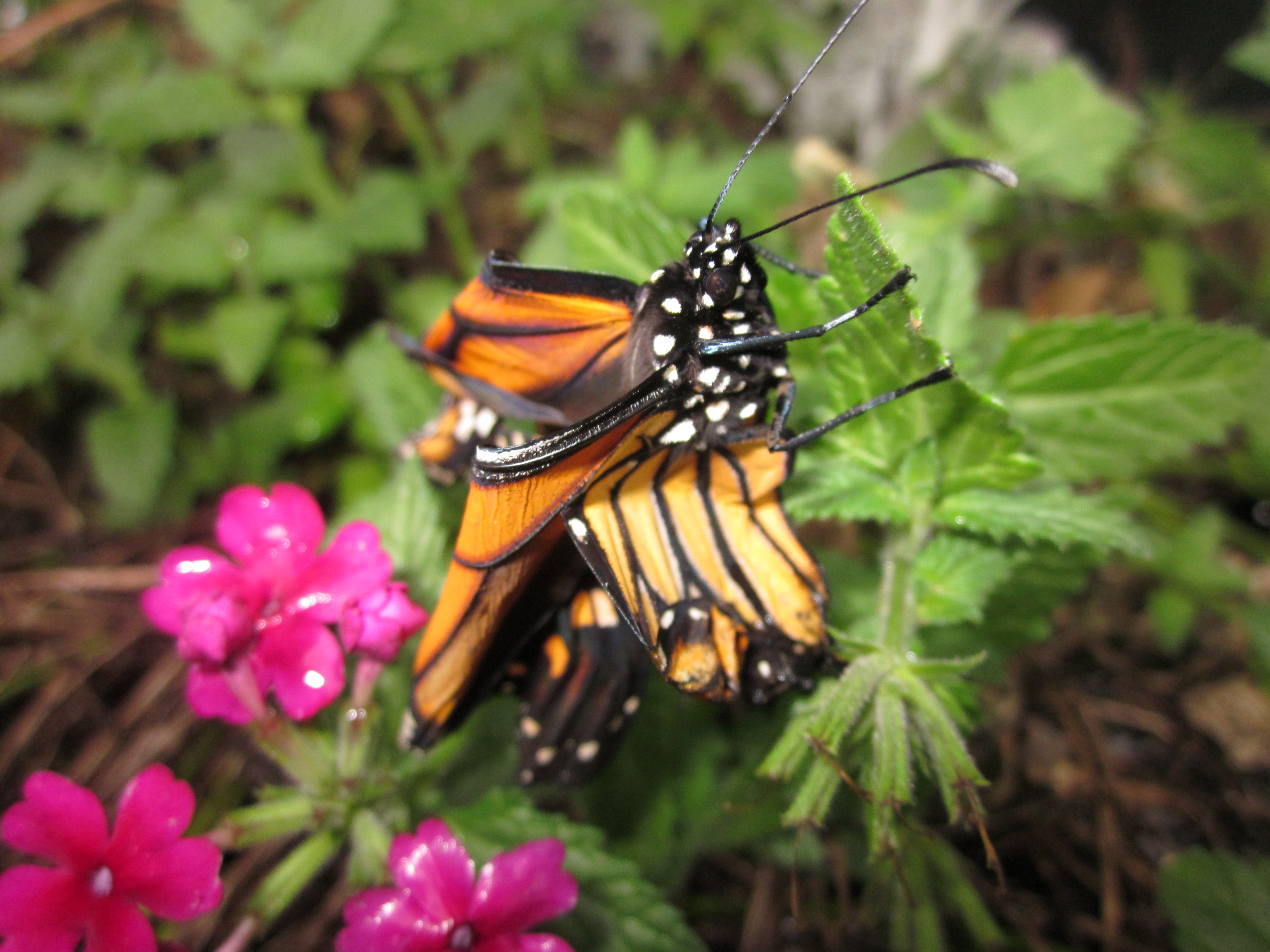
As soon as I awoke, I checked the tank. The last chrysalis hung empty.  The butterfly had fallen– wings splayed as if frozen in flight– to the bottom of the tank. At first, not having my glasses on, I thought it may have died there. With my glasses on, I could see its legs were moving like the proverbial beetle that lands on its back and expends its life’s energy trying to right itself.

Butterflies have tiny hooks on the ends of their feet, perfect for grasping. I placed a rolled-up paper towel within its reach and was relieved to see that it had the strength to climb onto the edge of the paper towel, allowing me to lift it off the bottom of the tank. Its wings were dry and did not appear to be damaged by the fall.

Last year I had the sad occasion to find, too late, that one of my butterflies had fallen while its wings were still wet.  Its wings had not had a chance to become straightened and they dried crumpled and misshapen. Because of this, the butterfly would never be able to fly away.  I called this butterfly Little Crinkle-Wing.  I placed it in my garden and fed it sugar water each day. For several weeks it walked wherever it wished to go until the hard frost came.

I was relieved to see that this last butterfly, emerging so late as it was, had not been crippled by its fall.  Instead, it hung upside down as butterflies do for hours after emerging.  My guess is that while hanging there, it is trying to become familiar with all its new parts: a brand-new body with wings, legs, antennae, and a long straw-like proboscis.

This afternoon, I will release it into the promise of sunshine, so it can find its way south. It will be a treacherous flight made so by the fact that it has emerged several weeks after most of its brothers and sisters.  It will make its flight alone through shortened days and biting winds.

When I let my mind go deep, I think of how much we are like monarch butterflies. We are born small and vulnerable and change over time, being forced to cope with bodies that often seem unfamiliar to us.  Like the lone butterfly in the tank this morning, some of us fall.  If we are lucky enough to land safely on our backs, we find ourselves in the awkward position of acknowledging that what we truly need can only be provided by someone else–not an easy lesson for creatures who are so accustomed to being self-sufficient.  The long journey ahead to warmth and sun and safety is not an easy one for them—or for us. Sometimes winds push us off course. Sometimes what we desperately need is out of our reach.  And always, always, there is the possibility of a hard frost.

The best we can do is be willing to allow others to lift us up. All of us yearn to climb high where the sun is warm and the breeze is gentle.  As the years unfold, our destination–so elusive during the early journeying years–finally opens itself to us: it is that perfect place within–a deep, pure place to reside even after a hard frost takes us.