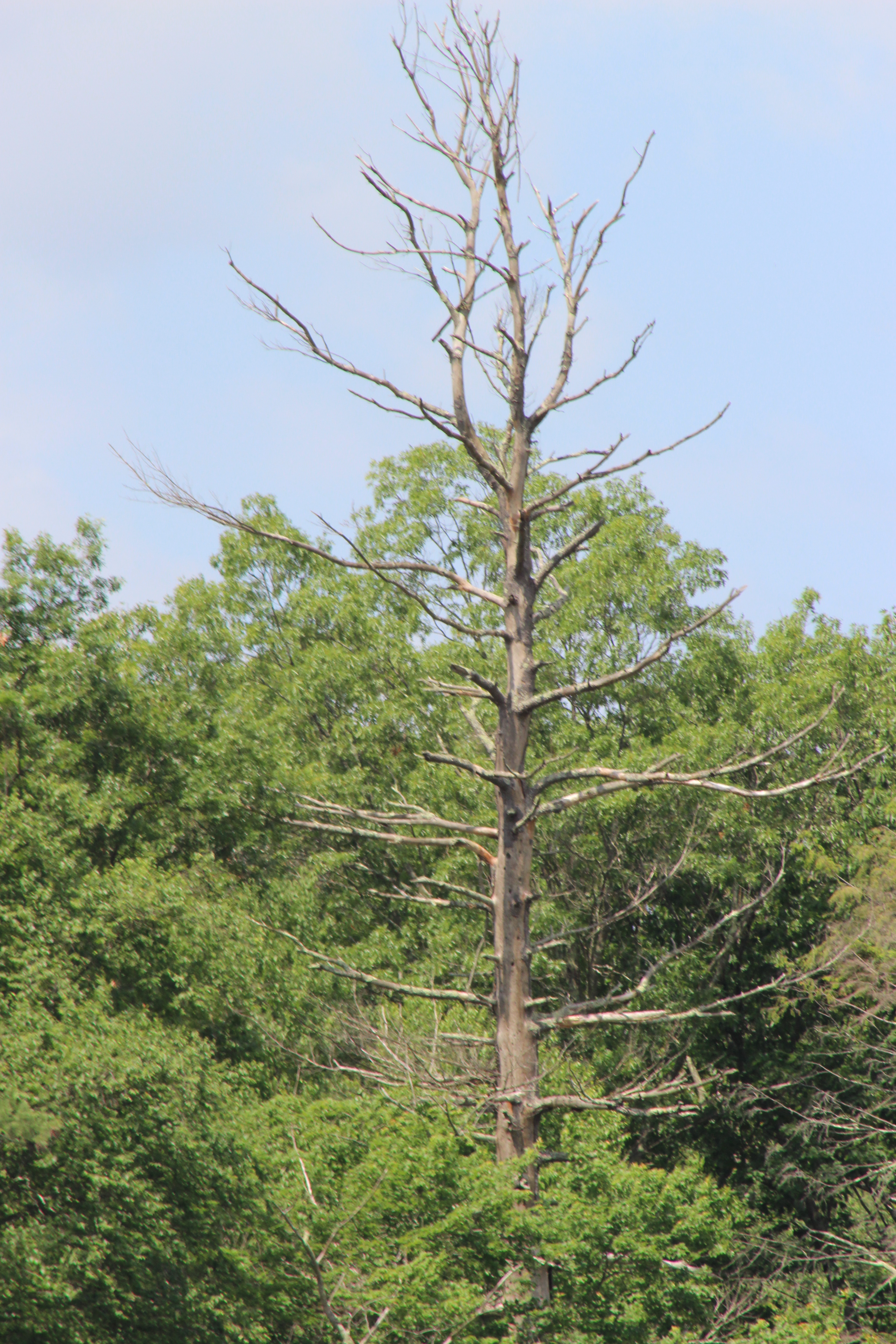
She could see the skeleton tree from the back seat as we drove along Route 97. I noticed it, too–set way back from the road, its bleached branches raised upward in frozen supplication–a stark image against the leafy trees that surrounded it.
“How come that tree has no leaves?” she asked. The way her little voice lilted upward at the end of each question brought a smile to my heart.
“That tree died a long time ago, so it can’t grow leaves anymore,” I explained. I wanted to keep my explanation simple and antiseptic. Surely by adding the words “a long time ago,” its death would seem less immediate and therefore less frightening–more like something you might read in a history book before turning the page. The truth was that I needed the distance from its death more than she did. Discussing the death of any living thing put me in an uncomfortable frame of mind, but she wasn’t going to let it rest.
“Why do trees die?” she asked.
Plausible reasons scrolled through my mind. I filtered them, keeping some, rejecting others. “Some trees die because they get sick. Some just get too old to live. Some are pushed over in storms, and others don’t get enough food or water.” It was the perfect answer for an inquisitive three-year-old—a blend of detail and simplicity. I was proud of myself, ready to close the book on this part of our conversation and move to another topic.
“But why do they die?” she asked again. I felt my mind being pulled toward philosophical treatises, spiritual wanderings, and cosmic truths, but she is only three years old, so I stuck to literal biology.
“All living things die eventually.”
As soon as the words escaped my lips, I realized my answer had the potential to upset her. Her response was immediate.
“I’m not going to die. I eat food and I drink water.”
I could see the connections she was making: She is not old or sick, and she stays inside during storms. She has plenty to eat and drink, so, of course, she will not die like the tree on the side of the road. She had formulated this totally logical conclusion, so who was I to dispute it? I carefully agreed with her, without telling a lie.
“Yes, you do eat food and drink water,” I said, glancing in the rear view mirror to scan her face for signs of distress. She was smiling, and it was clear that her mind was already preoccupied with other thoughts.
Mine was not.
Those innocent words–“I’m not going to die”—punctured a deep, dark place in my mind, unleashing a swarm of hellish possibilities that usually wait to torment me in the darkest hours of night. Grotesque images grabbed at my mind and taunted me. They threatened to do her unspeakable harm as she prattled on about sweet, simple things.
I felt panic rise to my throat. An overwhelming urge came over me to pull the car to the side of the road, rush to her and hug her tightly. I wanted to bury my face in her curly blonde hair, and shield her from the terrors of life’s what-ifs.
Instead I drove on.
She spoke innocently about cows and geckos and imaginary friends while I wrestled my hideous, bone-chilling fears back to the dark, cavernous hollows of my mind. If only I could bury those demons deeply enough, I thought. If only I could lock them away for eternity. Surely, I reasoned, if I could do that, they would never find her.
 Little by Little in the Blink of an Eye