The Pool

oceanwaves

I clutched her little body to my chest as we bobbed in the clean warmth of the water.  I was careful to hold her up so her lips stayed above the surface as she chattered.  She was wearing a life preserver, so there was no real danger of her slipping below the water, even though I was aware that we were nearing the point where the bottom of the pool slopes away. Sure enough, in one more step the bottom fell away and disappeared.  I was over my head, treading water.  A sense of panic—born of a childhood experience of being over my head and held down against my will—rose up.

It was a hot, humid day and the pool was packed.  Children dove and splashed, turned and swam.  Squeals and shouts and laughter rang out all around us.  She was laughing, too, until a small wave caught her just as she took a breath.  She sputtered and choked.  “This pool is wavy,” she remarked after one last cough.

Before I could answer her, a great, guttural sense of grief washed over me.  Within my mind and against my will I was in a place thousands of miles from our sunshiny-safe existence.  For that one brief moment I was a salt-soaked refugee, clinging desperately to his child in the middle of an unforgiving sea.

My feet scrambled and searched for a place to touch.  As I inched my way to the side of the pool with my granddaughter’s arms clinging happily around my neck, I could not shake the sense of despair I felt for the refugee.  The sea’s salt waves are relentless and his feet cannot touch.

My heart cannot shake the sadness it feels for thousands of those who would gladly take my place on this beautiful day.  Climbing from the pool to dry off, both guilt and gratitude fight for a space within my heart.  All I can do is pray that the refugees find the sanctuary of a welcoming shore.

Shades Of Brown

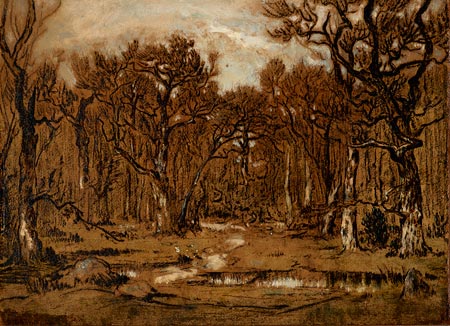
The Untamed Landscape by Theodore Rousseau

We were driving along an interstate highway on a February day, just the two of us. I have no recollection of where we were headed or whether it was sunny or overcast, but I remember being grateful for the heater that kept the chill away from his bones. He felt the cold more keenly than I did, so I purposely set it warmer than I would have liked. I drove no faster than the speed limit and kept to the right lane, passing cars sparingly and using my blinker as I had been taught. I gently pointed out each approaching rest stop in case he hadn’t noticed the road signs–he often needed to stop a while to stretch his legs. Our trip was a leisurely, comfortable one with conversation that flowed around moments of intermittent silence–the kinds of pauses whose durations are not discernable between two people who are at ease with one another.

I remember making a mental note of how bleak the landscape seemed as we passed mile after mile of leafless tree limbs, skeletal foliage, and ice-encrusted rocks.  It was at that exact moment he said it:  “Who would have thought there could be so many shades of brown?”

His casual observation caught me by surprise.  He could not have known what I had been thinking just a moment before, and the very coincidence of it seemed like an unintended rebuke for allowing myself to sink into negative space.  His comment tugged at my better nature. I was seeing “bleakness” while he was marveling at the “many shades of brown.”  He had chosen to share this with me at exactly the moment that I could see nothing but lifelessness.  Could this be an example of the Universe using a serendipitous collision of two mindsets to teach me a lesson?

The lesson was not lost on me.  Within an instant, the snowless winterscape became a panoply of possibility.  Different shades of brown emerged and moments later, a subtler assortment of browns made themselves known to me–each vibrant in its own right, worthy of being given its own name and place in Nature’s crayon box.

Grey-brown tree limbs reached up to finger the wind as green-brown grass lay flattened, resting.  Tanned-brown cattail heads stood stalwart against an onslaught of cold.  Purple-brown berry vines bowed in gentle tangles of repose against a millennian backdrop of black-brown rock.   Russet-brown leaves huddled along the roadside edges, chasing the cars as they passed.  What had seemed lifeless and bleak just moments before became fully alive and transformed by a change of mindset and a willingness to see beyond the surface.

I’ve thought about all the ways my father transformed my life without even knowing he had done so.  I never shared with him how his off-hand comment about “the many shades of brown” in winter affected me.  That one moment in time tripped a reset button in my mind and heart, opening my eyes to a world of beauty which had always been there.  It was hidden in plain sight along the interstate, waiting for me to be ready to see it one cold winter day.

The First Time I Saw My Father Cry: November 22, 1963

I’m sure my father cried well before the time I saw him. There had been sadness and loss in our home in the days after my Grandpa—his own father—died. Three years before that, a pall of grief and sorrow settled upon us and never quite went away after my mother came home from Mercy Hospital with empty arms—arms that should have held her infant daughter, their third child. When I think upon it now, I’m sure he was crying during the times that he could not be found. Dad never went far, but I’m sure he hid somewhere when the emotions that embarrassed and confounded him threatened to spill over.

I remember the first time I saw my father cry. It scared me to see him that way, like maybe life wasn’t as secure and predictable as he had always made it seem. After the day of seeing him cry, I looked at my dad with vigilant eyes. He was my weather vane, my barometer. I began taking notice of how things affected him. I felt my happiest when he looked happy.
It was a Friday afternoon in late November, 1963. An unspeakable act had been committed: our thirty-fifth president was shot and killed by an assassin as he rode in an open convertible through the streets of Dallas, Texas. Coverage of this national tragedy dominated the airwaves throughout the weekend. It had never been our custom to leave the television on during the day, but the enormity of the tragedy required an exception. A relentless, gray-blue beacon of solemn sorrow emanated throughout our home, reminding us of our nation’s collective grief. At times one or another of us would sit and watch for a while. Most of the time we silently tiptoed past it in much the same way as we tiptoed upon arriving at church after mass had already begun. Our house was errily quiet.
When I realized that I hadn’t seen my father for several hours, I went looking for him. Our car was in the driveway, which meant he was home, but he wasn’t outside or in the garage. That left the basement.
Dad had high hopes for the basement after he had refinished it. He regarded it as a play room for his children and a spacious place for family gatherings. He paneled it in a pale, golden wood tone, put down a ken-tile floor, and built a well-stocked bar overlooking a fish tank full of live-bearing guppies with neon-colored tails. The main room was decorated in a nautical theme, and a portable, black and white TV rounded out the furnishings. “Why don’t you play in the basement?” my mother would ask, but I never did unless there were lots of cousins down there with me at holiday time. No matter what Dad had done to it, it was still a basement, and no matter how much I tried to tell myself that there was nothing down there that could hurt me, it was still a dark and scary place.
I opened the basement door and peered down the stairs. A blue, flickering light lit my way as I crept down each stair. When I reached the bottom step, my eyes followed the glow of the television to the place where my dad sat. He was bent forward, his elbows resting on his knees. He was weeping silently, holding his head in his hands.
John Kennedy and Dad were about the same age. Both of them served in the South Pacific during the war, came home, married, had children, and made a life for themselves. Dad had voted for JFK, who was a Roman Catholic and a Democrat. The president’s lovely young wife captivated us with her beauty and grace. His children amused us by playing under the president’s desk in the Oval Office. There was youth and vitality in the White House again. “It is Camelot,” people said.
As our young president lay in State in the Capitol Rotunda, as his black-veiled widow knelt beside his casket, as his three-year-old son saluted him, Dad wept for all that had been lost.
I do not know whether my father sensed that I was there with him for those brief moments. I did not call out to him, and he did not look up. I crept back up the steps, being careful to avoid the creaky places that I knew by heart. We never spoke of it, and it wasn’t until many years later that I ever told anyone about my father’s secret tears.
In his later years my dad and I cried together–mostly after bourbon manhattans and mostly over regrets. After years of holding them at bay, the things he had done during the war years demanded a voice. He told his stories and asked me if I thought it was possible that God might punish his grandchildren or his great-grandchildren for the sins he had committed. Tears came freely and emptied themselves down our cheeks as he spoke of atrocities and the possibility of forgiveness.
As my mind reached back through the decades to that first time I had seen him cry alone in the darkness of our basement, I wondered if he sensed how far he had come. In the twilight of his years, my father was finally ready to share his tears in the full light of day.

Children Always Know

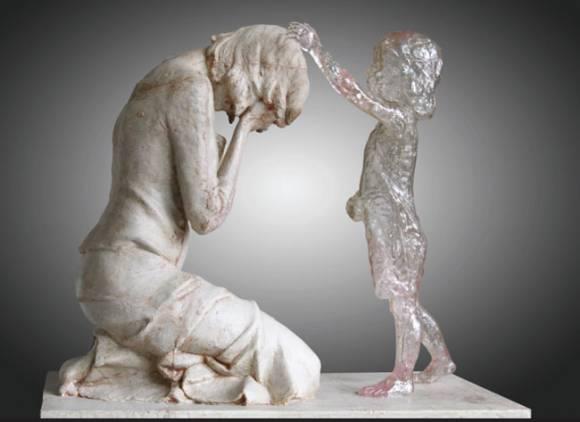
grieving mother sculpture

Children always know when something is wrong.   Adults may think they are shielding them from grief, anguish, and sorrow, but children take it all in and feel it anyway.  If adults aren’t square with them, if they don’t acknowledge their own feelings and level with their children, their little minds will fill in the blanks, making them fearful and anxious in the absence of hard facts. 

There was a time when people thought children could not possibly feel the sorrow that adults feel.  Conventional wisdom led those adults to believe that it was best to leave children out of the grief process, to spare them as if sorrow could not possibly concern them.  It doesn’t matter whether this attitude was born of ignorance or expediency; the result was the same–for the children who felt the sorrow but didn’t understand what was causing it, it was like being dropped off on a strange street corner far from home in the middle of the night.  Alone.  Emotionally abandoned.  

You may wonder how I know all this.  I learned it firsthand.

The birth of my first sibling took me by surprise.  I have no memory of having noticed my mother’s rounding belly, signaling my brother’s impending birth.  It wasn’t pointed out to me or discussed in front of me.  I don’t remember any gleeful adult chatter about the prospect of becoming a big sister.  No one asked me if I wanted a little brother or a little sister. I was only three then, and it was the early 1950’s–a time of emotional restraint, a time when children were still expected to be seen and not heard—a time when a woman did not announce her condition until well after the first trimester, when her belly could speak the words for her.

No one used the word “pregnant” in polite company back then and to this day, the very word sounds crude to my ears.  It was, instead, referred to as a “blessed event” or “being in the family way.”  It was certainly considered inappropriate to speak about such things in front of children and so when my brother was born in early November, 1953, it was quite literally as if he had magically appeared and was brought home to live with us.

My mother had been taken to Mercy Hospital in the middle of the night to have her third child in the Spring of 1956. I was six years old by this time and I remember being wildly excited for the possibility of a baby sister, chatting merrily and excessively about the baby, asking my grandmother when mommy and the new baby would come home.  The more my questions were left unanswered, the more insistently I asked them.

But something wasn’t quite right.

My daddy, usually so sunny and animated, seemed sad and distant.   It was impossible for me to know what was wrong, but I felt his sadness and it scared me.  I tried to make him laugh.  The best I could draw from him was a weak smile. The adults spoke together in hushed, closed circles.  I couldn’t hear their actual words, just their somber tones.  A sense of dread settled deep within my stomach.

I was sent to my cousins’ house after school.  I had never been sent there before and my stomach ache grew worse.   Even though they lived in the same neighborhood, I felt like I was being banished to a foreign land.  Although they were my second-cousins and they lived around the corner, I never went there to play.  Only now can I admit that I never really felt comfortable around them.  I never really liked them.

There was a lot of drama and yelling in my cousins’ household—lots of teasing, complaining, tattling, yelling.  I didn’t want to be around people who yelled.  I wanted to go home where things were calm and predictable, but the dread that filled my belly warned me that there was a good chance that place didn’t exist anymore.

The girls on their street played different games than we played on my block.  One of the games involved laying on our backs in the grass and looking up at the clouds to see what shapes emerged. When we saw a shape, we were supposed to call it out.  I remember stretching out on the front lawn with them and dutifully looking up, but I didn’t want to look at the clouds.  I just wanted to go home.  A terrible headache blurred my eyes and my stomach was filled with dread.  I just wanted to be home in my own bed, so I got up and began to walk away.  I was half way home before they chased me down and brought me back.

Dinner felt strange at their house.  They sprinkled sugar on their tomato slices rather than salt.  I so desperately wanted to go home where things made sense.  Putting sugar on tomatoes made no sense to me.  To this day I remember those tomatoes and how strange and unwelcoming it felt to sit at their dinner table.  I felt trapped and vowed never to go back there ever again.

The next day my grandma arrived and I was able to sleep in my own bed.  My mother and father were still suspiciously absent, but I felt grateful to be in my own home with my grandma.  I played with my own friends on my own block and my stomach stopped hurting for a while. I began to relax until I caught the words of our neighbor who came to speak to my grandma over the split rail fence as she hung the wash on the clothesline.

My neighbor spoke in hushed tones, but just loud enough for me to hear.  Impossible words tumbled from her lips, “I am so sorry.”

My mommy and my new baby sister were due to come home the next afternoon.  It was decided that I should be allowed to stay home from school to welcome them.  I remember being in the bathroom that morning, ecstatically brushing my teeth when my grandma came in.  She spoke in a solid, authoritative voice, giving me no hint of what was to come.

“Mommy is coming home today, but she won’t be bringing home the baby.  The baby died.”  I dropped my toothbrush and burst into messy, gulping, howling tears.  My grandma continued as best as she could.  I remember the hitch in her voice as she spoke.

“Now stop crying and wash your face.  You need to be a good girl for your mother.  She is very sad.”

I tried to be a good girl.  I tried to be helpful and cooperative and quiet, but I was only six.  Years later I suffered from depression, and in therapy I learned that unresolved childhood grief can result in depression later in life.

I was not encouraged to cry for my baby sister or talk about her and in all the years after her death, we rarely spoke her name.   A nurse had hastily baptized her before she took her last breath, christening her with the name Bernadette.  Her name, so unlike any name our parents would have chosen, was the only proof that she had ever existed.

Bernadette.  My confirmation name.

Bernadette.  The middle name my parents chose for my second baby sister—the one who did come home with mommy two years later.

Bernadette. After sixty years, I can still feel the dread of not knowing. And I still cry for you.

Of Slow-Motion Magic and Bent-Kneed Miracles

2015-10-17 Hidden miracles of Autumn 004

Autumn trees are magicians.  They work slow-motion magic in the silence of October nights as darkness wrestles minutes from each day.  Preordained frost becomes their magic wand, turning weary leaves crimson, russet, persimmon, scarlet, gold.

Summer’s steady, stalwart green transforms against its will, becoming showy flash and fiery glow.  Sweatered seekers roam rural roadsides for Autumn’s treasure–apples, cornstalks, pumpkins, cider, pots of mums, and flowering kale. But Autumn’s magic does not end with these alone.

There is so much more to see.

There are humbler miracles–low to the ground–easy to miss in deep Fall.  Stealthy chill fingers turn flower stems dry and leaves to mottled gray.  As their little lives ebb, they crumble and bend under the weight of crisp seed pods which crack and open in the sun, releasing tiny promises to the ground below.

In deep Fall the once pert and perfect gardens of Summer become wizened tangles of naked stalks and fallen leaves and bowed brown flower heads.   Upon a closer, bent-kneed look, good fortune may show you a final bloom—small, vibrant, perfect–a final gift before the frost.  These tiny gifts sit still and wait for keener eyes to see.  They are the magical ones—the ones who have summoned their waning energy for one last chance to blossom, giving us a final gasp of beauty before the hard frost.

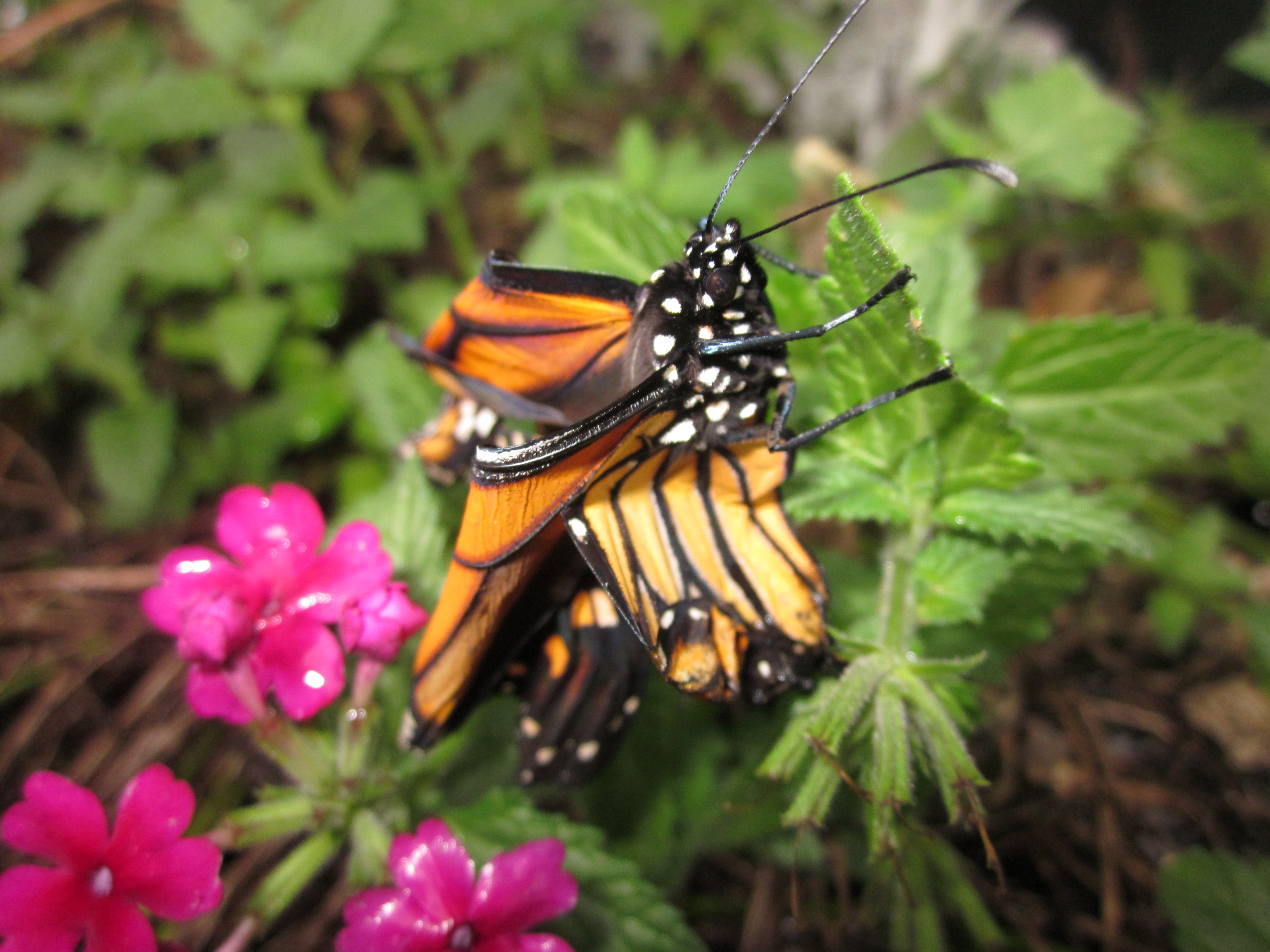
Fallen Monarch

Little Crinkle Wing

Little Crinkle Wing

Just this morning upon arising, I checked the last butterfly chrysalis in the terrarium–an old fish tank whose leaky seams prevent it from holding water, but make it perfect for holding the stems of milkweed I pluck from my garden each day.  Milkweed is the only plant the monarch larvae will eat and there have been many growing and thriving in my tank over these last weeks.

After growing from microscopic squiggles to fat, robust caterpillars, something within the caterpillars’ bodies tells them it’s time to stop eating.  This urge tells them to climb to the highest point they can find. In the wild, that can be almost anywhere but in this case, the highest point is the wire screen which covers the top of the glass tank.  After they settle upon a suitable spot, they affix themselves from their back end and hang upside down for several days.

Metamorphosis begins when the caterpillar pulses and writhes out of its skin. This takes less than five minutes.  At first, its green insides hang naked and exposed but in an hour’s time, those insides smooth out and harden into a pale green chrysalis.  That’s where the magic of becoming a butterfly begins.

As soon as I awoke, I checked the tank. The last chrysalis hung empty.  The butterfly had fallen– wings splayed as if frozen in flight– to the bottom of the tank. At first, not having my glasses on, I thought it may have died there. With my glasses on, I could see its legs were moving like the proverbial beetle that lands on its back and expends its life’s energy trying to right itself.

Butterflies have tiny hooks on the ends of their feet, perfect for grasping. I placed a rolled-up paper towel within its reach and was relieved to see that it had the strength to climb onto the edge of the paper towel, allowing me to lift it off the bottom of the tank. Its wings were dry and did not appear to be damaged by the fall.

Last year I had the sad occasion to find, too late, that one of my butterflies had fallen while its wings were still wet.  Its wings had not had a chance to become straightened and they dried crumpled and misshapen. Because of this, the butterfly would never be able to fly away.  I called this butterfly Little Crinkle-Wing.  I placed it in my garden and fed it sugar water each day. For several weeks it walked wherever it wished to go until the hard frost came.

I was relieved to see that this last butterfly, emerging so late as it was, had not been crippled by its fall.  Instead, it hung upside down as butterflies do for hours after emerging.  My guess is that while hanging there, it is trying to become familiar with all its new parts: a brand-new body with wings, legs, antennae, and a long straw-like proboscis.

This afternoon, I will release it into the promise of sunshine, so it can find its way south. It will be a treacherous flight made so by the fact that it has emerged several weeks after most of its brothers and sisters.  It will make its flight alone through shortened days and biting winds.

When I let my mind go deep, I think of how much we are like monarch butterflies. We are born small and vulnerable and change over time, being forced to cope with bodies that often seem unfamiliar to us.  Like the lone butterfly in the tank this morning, some of us fall.  If we are lucky enough to land safely on our backs, we find ourselves in the awkward position of acknowledging that what we truly need can only be provided by someone else–not an easy lesson for creatures who are so accustomed to being self-sufficient.  The long journey ahead to warmth and sun and safety is not an easy one for them—or for us. Sometimes winds push us off course. Sometimes what we desperately need is out of our reach.  And always, always, there is the possibility of a hard frost.

The best we can do is be willing to allow others to lift us up. All of us yearn to climb high where the sun is warm and the breeze is gentle.  As the years unfold, our destination–so elusive during the early journeying years–finally opens itself to us: it is that perfect place within–a deep, pure place to reside even after a hard frost takes us.

Circles, Part 1

circles, zentangle

Circles.  I have always loved circles.  As a young child I drew them in the sand at the beach and in muddy soil in my backyard.  I drew them with chalk on the street in front of my house and doodled them in English class–around and around and around, hypnotically making circles within circles, different sizes, but always the same shape.

No matter where I was—the beach, the sidewalk, or a parking lot—if I happened to spy a pebble that looked like a perfect circle, I’d stoop down, scoop it up, and put it in my pocket.  I still do this, I might add.  I especially love rocks worn smooth by the tumbling action of waves upon sand.  Their smooth, rounded perfection calls to me. Once nestled in the deepest part of my pocket, it is mine–a treasure waiting to soothe weary fingertips.

It is said that it is impossible to draw a perfect circle freehand–unless you are Giotto di Bondone.  He was an Italian artist from the early fourteenth century who broke from the artistic tradition of his time and painted realistic forms exactly as they appear in nature. The story of Giotto’s circle—the perfect, red O he painted when asked to give a sample of his work  to the Pope—is legendary in the world of visual art.

“Pope Benedict lX wanted to commission some paintings for St. Peter’s and so he sent a courtier around to find the best painter in Italy. The courtier asked all the artists to give him a sample of their work to send to the Pope. He came to Giotto’s workshop, explained his mission, and asked him for a drawing which would give the Pope some idea of his competence and style. “Sure,” said Giotto; and he laid down a sheet of paper, reached for a brush dipped in red paint, closed his arm to his side to make a sort of compass of it, and in one even sweep scribed a perfect circle. “There you are,” he told the courtier, handing it to him with a smile.

“That’s your drawing?” asked the courtier, who didn’t know whether Giotto was pulling his leg. “Is that all you’re going to send His Holiness?” “That’s more than enough,” said Giotto. “Send it with your other drawings and see whether it’s understood or not.” The Pope’s messenger took the drawing and went away trying to hold his temper. Did that little painter think he was a fool? When he got back to Rome he showed the Pope the big O and told him how Giotto had scribed it—freehand, without a compass. The pope and his advisers DID understand the achievement of that O and gave Giotto the commission.” (http://theorbitbrown.com/site/chris-orbit-brown)

Because a circle may be drawn from beginning to end without a break, it is a powerful symbol and the most common and universal sign found in all cultures.  It represents completeness and eternity. Ancient cultures believed that circles were sacred signs, symbolizing life, the seasons, the stars, planets, sun, and moon.  To this day the circle symbolizes the unending nature of love itself.

Circles are always with us. Our eyes—the windows of the soul, some say—have circular irises and pupils that invite just the right amount of light within to secure proper vision. Blood cells, transporters of life-giving nutrients, resemble circles under a microscope. Our arms, legs, and necks are built to accommodate circular motion. Our arms can encircle lover or child, offering comfort, protection, and promise. Our lips, where love begins with words and kisses, and our breasts, where new life is nourished, are soft and rounded and circular.  They are inviting and soothing to the touch.

I have always loved circles.


Labor Day

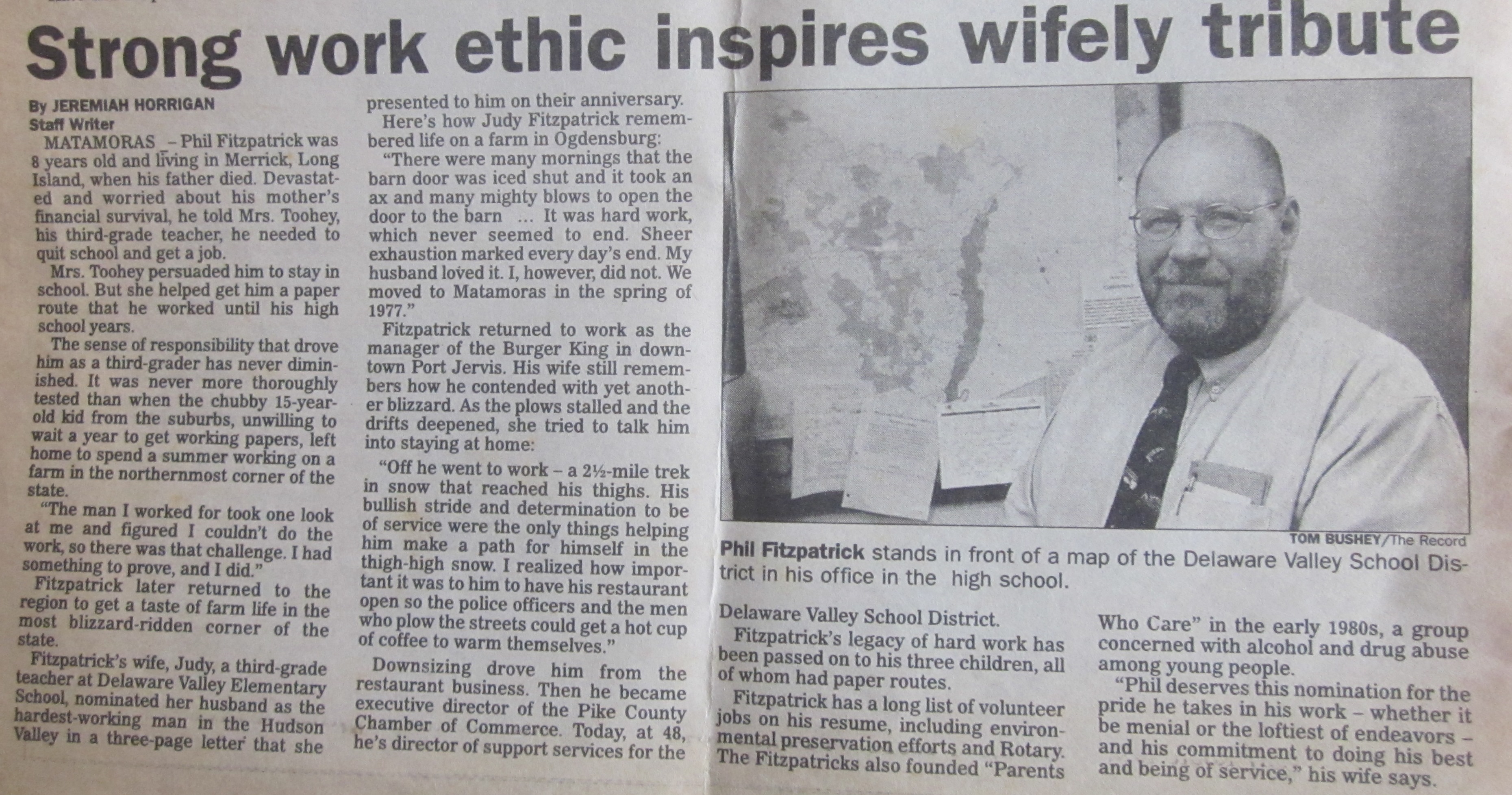
Hardest Working Man, 1998

He was eight years old and in the third grade.  He remembered having breakfast with his dad after his father had gone to daily mass. His dad took the train to work each morning and moonlighted as a cabby at night.  He was always tired and the boy rarely saw him, so having breakfast with his dad was a special treat.

It was April Fool’s Day, 1958. At first, the boy thought it was a cruel trick that someone was playing on him, but it wasn’t a trick.  His father never came home that night.

The boy’s mother didn’t want her children to go to the funeral home, but some of the aunts and uncles got to him anyway.  “You are the man of the house now,” they said.  “You must take care of your mother.”  At that very moment, the boy’s childhood was lost to him.  Now he needed to be responsible.  He needed to work.  He felt like his family’s financial survival depended upon him.

The day his father was buried, the young boy walked into the principal’s office and told him that he needed to quit school and get a job.  The principal was a very wise man and treated the child like the adult he was trying to become.

“Will you consider staying if I can get you a job after school?” the principal asked.  The boy nodded.  He arranged for the boy to have a paper route–120 papers to be delivered before dinner every day.  The boy rode his bicycle to every house, and he gave his mother every penny he earned.

His sense of responsibility never diminished.  He always found a job even when others could not, and he never slacked off.  At fifteen, he was too young for working papers, but that didn’t stop him.  He signed up for the farm cadet program.  Working papers weren’t required for farm work.

He was sent to a farm in Hammond, New York, ten miles from the Canadian border.  The farmer looked at the chubby boy from Long Island and was instantly disappointed.  Surely this portly teenager could not possibly be able to do the physical work required to run a farm, and he told the boy as much.  “This work isn’t for everybody.  There’s no shame in leaving,” he told the boy.  It was as if a gauntlet had been thrown; he silently accepted the challenge.  There was no way he was quitting.  That was the summer the hay bales were packed so tightly in the barn that it was difficult for the farmer to get them loose that winter.  Never had the farmer hired a stronger or more relentless worker.

The boy grew up, married, and became a father of three children before his twenty-seventh birthday.  Like his own father, he worked two jobs to support his family—managing a fast food business by day and working with a plumber at night.  Just like the boy he once was, his own children saw their father only for a brief time at the dinner table each night.

His dedication to serve was never more evident than in the winter of 1978 when blizzard conditions stalled the municipal plows and the snow drifts deepened, covering cars and fences.   His wife tried to persuade him to stay home.

“No one will be out.  The plows haven’t even come through.  How will you get to work?” she pleaded.  She worried that a three-mile walk down country roads at four in the morning could be dangerous, but he would not be dissuaded.  She watched him walk down the long driveway to the road, pushing through the thigh-high snow with his powerful legs.  His bullish determination and brute strength pushed him forward as he plowed through the snow with each stride.  He could not stay home.  He needed to open his restaurant to offer hot coffee and breakfast to the police officers who were on-duty and the men who plowed the streets.

As a young man, he preferred physical labor.  Over time he had worked with an electrician, a landscaper, a plumber, and a mason.  He worked in a lumberyard, a church, a gas station, and an ice cream shop.  The very last job he ever had was really five jobs rolled into one.  It was too much for any one person to do, but he did not give up and would not complain.  His wife was concerned for his health. “This job is going to kill you,” she once told him in exasperation. She meant it to be a shocking statement.  Maybe it would convince him to go to his boss and finally ask for help.  But he had never encountered a job that he could not do.  He was proud, so he worked all the harder.

Like all the other work he had ever done, he gave that last impossible job his all.  In the end, it took more than he had to give.  After he died, they hired three people to take his place.

Labor Day.  It is the day I think of that little boy and the man he ultimately became.  I honor his memory.  He was the hardest-working person I have ever known.  He was my husband.


Labor Day.   A time set aside to honor those who work—men and women who sweat to make a living, men and women whose occupations require bodily strength, intellect, or a combination of both, men and women who labor and sacrifice for the good of their families, their communities, and our nation.  

Labor Day.  A time to be thankful for the labors of our neighbors, our friends, and our family.  A time to honor those who came before us and acknowledge their contributions.  A time to say “thanks” to the hardest -working people we know.

Hardest Working Man, 1998

I’m Too Old for This, Part 2

First of all, I need to make one thing clear: I don’t like thinking of myself as old.  I believe the Buddha said it best thousands of years ago—What you think is what you become.  I’ve also read that the thoughts you conceive in your mind are tangible things and not entirely yours to keep secret and hold at bay.  Once you conceive of them, they are out there and the Cosmos runs with them.  (E2 by Pam Grout) Apparently, the Universe is quite willing to oblige you and make your thoughts a reality.  It turns out that the overused statement “You are only as old as you feel” actually has some merit to it where the Cosmos is concerned.

Just because I don’t think of myself as old doesn’t mean I’m an age-denier.   It simply means that I don’t feel like my chronological age and because of that, it’s not something I usually dwell upon.  I say “usually” because there are some emotions that crop up on a fairly regular basis nowadays– gratitude, for instance. I find myself feeling grateful for being able to lift heavy objects.  I am thankful whenever I stoop down and am able to get right back up again.  After working in my garden in the hot sun for several hours, I say a prayer of thanks for the strength and endurance it takes to do so.  That kind of gratitude never came up when I was younger–not because I was an ingrate–but because the ability to do those things were a part of being young.  Just like being able to breathe, I never thought twice about my strength, agility, or endurance.  Nowadays I am grateful for all those things.  It’s not a matter of dwelling on your age, it’s a matter of acknowledging it.

I’m not sure when this started, but I find it amusing to test myself with silly physical challenges. Instead of sitting down to put on my socks and sneakers, I put them on standing up so I have to balance myself on one foot while doing so. The trick is, of course, not to fall over and it’s not as easy as it sounds. Whenever I squat down to pick something up, I challenge myself to get back up using the power of my legs without holding on to anything.  Sometimes I try to run up the stairs by twos the way I did my entire childhood life, skipping every other step to the top.  I did these things unconsciously as a younger person, but now I do them on purpose.

Chronological age informs life’s everyday decisions, regardless of whether you feel like you are that age, or not.  It influences what you wear, what you eat, and where you like to go.  Take clothing for an example.  I have never been a fashionista but in my younger years I made some uncomfortable fashion choices in the hopes of looking good enough to be noticed.  Let’s face it, I was looking for compliments along the lines of “You look sexy!”  Nowadays, I stay away from uncomfortable clothes at  all costs. If you were to look in my closet, you’d see that my wardrobe has distilled itself down to simple, comfortable clothing: jeans that have a little stretch in the weave, solid colored crew-neck shirts, and comfortable shoes.

And as far as compliments?  I’m a realist.  I’ll be happy with “You look nice.” Just don’t tell me I look old.

I’m Too Old for This


“Act your age.”

How many of us heard this as we were growing up?  I, for one, was never sure what was expected of me when those three words came my way.  I knew that they meant I was doing something unacceptable but apart from that, I never really understood what I should be doing instead.  Where was it written that we needed to “act our age” and what did that mean anyway?

I pictured an ancient tome of encyclopedic scope, listing all the objectionable behaviors to avoid, hidden away on a dusty shelf somewhere. I imagined that it contained information on what was expected and what was prohibited for each year of a child’s life.  I wondered when it was written and by whom, and if there was a magical age one must reach before its contents were finally revealed.  I was pretty sure that whatever that magical age was, it was probably too late for me.  It had already done its damage. Without ever having laid eyes on it, that book had left a dark smudge upon my self-concept. Opening it up and peering within didn’t seem like such a good idea.  “Acting my age” had eluded me for so long that I didn’t really want to mess with it.

Once you become a senior citizen, “acting one’s age” takes on a new, softer meaning.  This was brought home to me in the Sunday Styles section of the “New York Times” this weekend where Dominique Browning’s article entitled, “I’m Too Old for This” sat front and center on page two, begging me to read it. (http://www.nytimes.com/2015/08/09/fashion/im-too-old-for-this.html?_r=0)

What did she feel she was too old to do? I wondered.  Was this going to be a long list of don’ts, a geriatric version of “act your age”?  Was she going to extoll the virtues of giving up youthful endeavors and giving in to self-censorship? Thankfully, she did none of that. Instead she quickly established that advancing age brings with it a certain kind of freedom–the ability to acknowledge and free oneself from troubling situations, negative people, and toxic mindsets by repeating the simple mantra, “I’m too old for this,” then letting those things go. I breathed a sigh of relief and understood immediately.  I have felt the freedom she speaks about.

“I’m too old for this.” My mind cannot let these words go.  Indulgent thoughts urge me to play along with them.  I will see where they take me.

I’m not done with being “too old for this.”