Little Crinkle Wing
Just this morning upon arising, I checked the last butterfly chrysalis in the terrarium–an old fish tank whose leaky seams prevent it from holding water, but make it perfect for holding the stems of milkweed I pluck from my garden each day. Milkweed is the only plant the monarch larvae will eat and there have been many growing and thriving in my tank over these last weeks.
After growing from microscopic squiggles to fat, robust caterpillars, something within the caterpillars’ bodies tells them it’s time to stop eating. This urge tells them to climb to the highest point they can find. In the wild, that can be almost anywhere but in this case, the highest point is the wire screen which covers the top of the glass tank. After they settle upon a suitable spot, they affix themselves from their back end and hang upside down for several days.
Metamorphosis begins when the caterpillar pulses and writhes out of its skin. This takes less than five minutes. At first, its green insides hang naked and exposed but in an hour’s time, those insides smooth out and harden into a pale green chrysalis. That’s where the magic of becoming a butterfly begins.
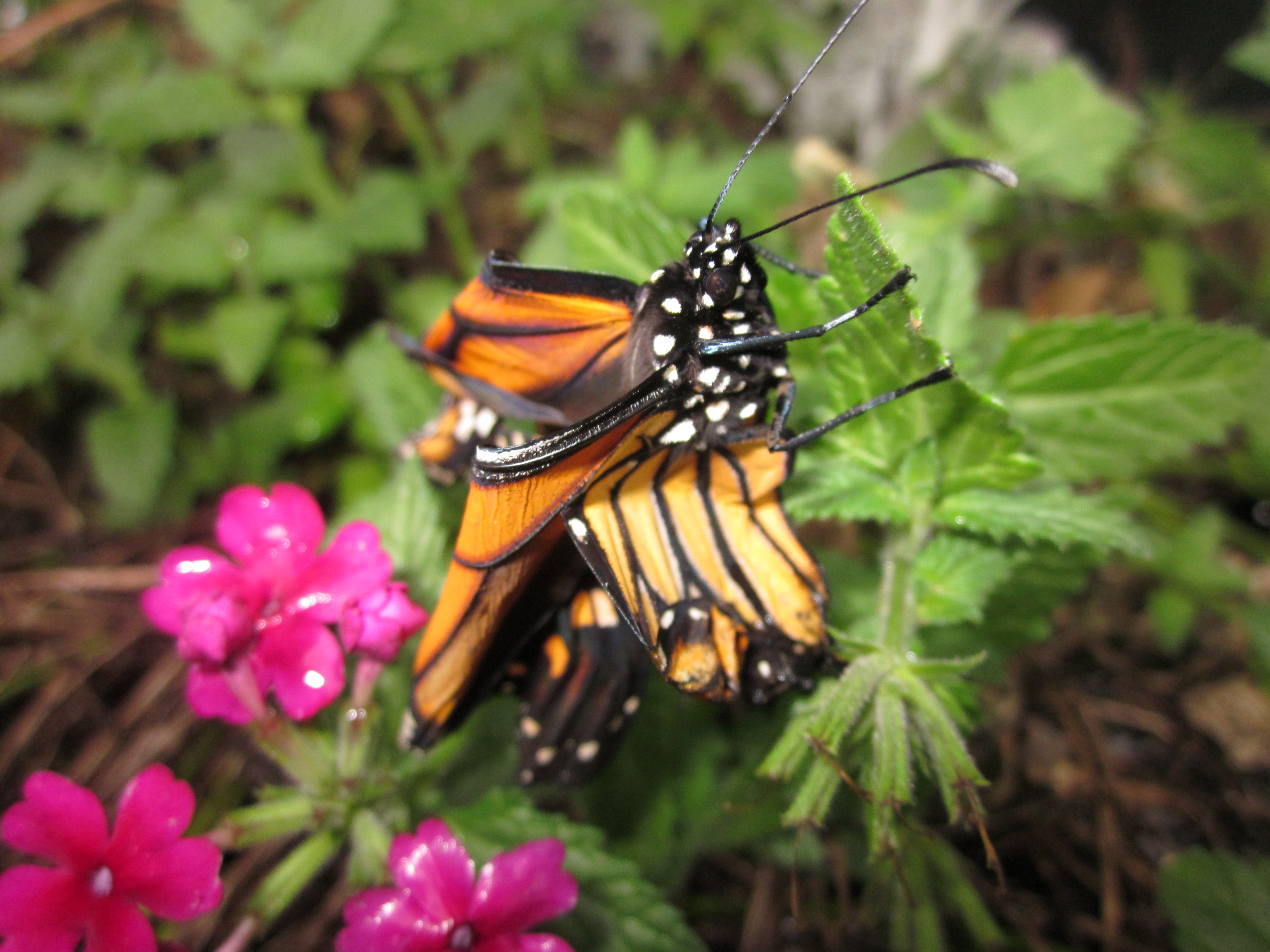
As soon as I awoke, I checked the tank. The last chrysalis hung empty. The butterfly had fallen– wings splayed as if frozen in flight– to the bottom of the tank. At first, not having my glasses on, I thought it may have died there. With my glasses on, I could see its legs were moving like the proverbial beetle that lands on its back and expends its life’s energy trying to right itself.
Butterflies have tiny hooks on the ends of their feet, perfect for grasping. I placed a rolled-up paper towel within its reach and was relieved to see that it had the strength to climb onto the edge of the paper towel, allowing me to lift it off the bottom of the tank. Its wings were dry and did not appear to be damaged by the fall.
Last year I had the sad occasion to find, too late, that one of my butterflies had fallen while its wings were still wet. Its wings had not had a chance to become straightened and they dried crumpled and misshapen. Because of this, the butterfly would never be able to fly away. I called this butterfly Little Crinkle-Wing. I placed it in my garden and fed it sugar water each day. For several weeks it walked wherever it wished to go until the hard frost came.
I was relieved to see that this last butterfly, emerging so late as it was, had not been crippled by its fall. Instead, it hung upside down as butterflies do for hours after emerging. My guess is that while hanging there, it is trying to become familiar with all its new parts: a brand-new body with wings, legs, antennae, and a long straw-like proboscis.
This afternoon, I will release it into the promise of sunshine, so it can find its way south. It will be a treacherous flight made so by the fact that it has emerged several weeks after most of its brothers and sisters. It will make its flight alone through shortened days and biting winds.
When I let my mind go deep, I think of how much we are like monarch butterflies. We are born small and vulnerable and change over time, being forced to cope with bodies that often seem unfamiliar to us. Like the lone butterfly in the tank this morning, some of us fall. If we are lucky enough to land safely on our backs, we find ourselves in the awkward position of acknowledging that what we truly need can only be provided by someone else–not an easy lesson for creatures who are so accustomed to being self-sufficient. The long journey ahead to warmth and sun and safety is not an easy one for them—or for us. Sometimes winds push us off course. Sometimes what we desperately need is out of our reach. And always, always, there is the possibility of a hard frost.
The best we can do is be willing to allow others to lift us up. All of us yearn to climb high where the sun is warm and the breeze is gentle. As the years unfold, our destination–so elusive during the early journeying years–finally opens itself to us: it is that perfect place within–a deep, pure place to reside even after a hard frost takes us.
 Little by Little in the Blink of an Eye