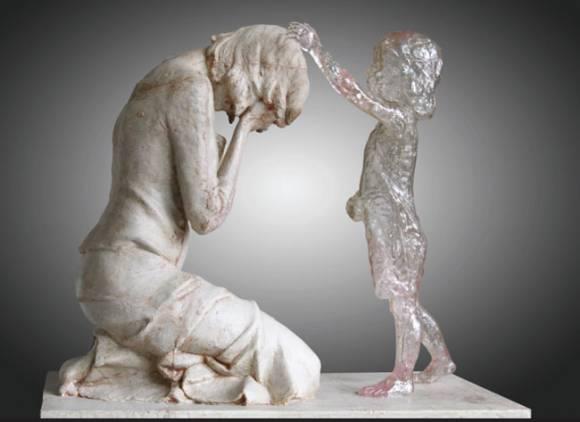
Children always know when something is wrong. Adults may think they are shielding them from grief, anguish, and sorrow, but children take it all in and feel it anyway. If adults aren’t square with them, if they don’t acknowledge their own feelings and level with their children, their little minds will fill in the blanks, making them fearful and anxious in the absence of hard facts.
There was a time when people thought children could not possibly feel the sorrow that adults feel. Conventional wisdom led those adults to believe that it was best to leave children out of the grief process, to spare them as if sorrow could not possibly concern them. It doesn’t matter whether this attitude was born of ignorance or expediency; the result was the same–for the children who felt the sorrow but didn’t understand what was causing it, it was like being dropped off on a strange street corner far from home in the middle of the night. Alone. Emotionally abandoned.
You may wonder how I know all this. I learned it firsthand.
The birth of my first sibling took me by surprise. I have no memory of having noticed my mother’s rounding belly, signaling my brother’s impending birth. It wasn’t pointed out to me or discussed in front of me. I don’t remember any gleeful adult chatter about the prospect of becoming a big sister. No one asked me if I wanted a little brother or a little sister. I was only three then, and it was the early 1950’s–a time of emotional restraint, a time when children were still expected to be seen and not heard—a time when a woman did not announce her condition until well after the first trimester, when her belly could speak the words for her.
No one used the word “pregnant” in polite company back then and to this day, the very word sounds crude to my ears. It was, instead, referred to as a “blessed event” or “being in the family way.” It was certainly considered inappropriate to speak about such things in front of children and so when my brother was born in early November, 1953, it was quite literally as if he had magically appeared and was brought home to live with us.
My mother had been taken to Mercy Hospital in the middle of the night to have her third child in the Spring of 1956. I was six years old by this time and I remember being wildly excited for the possibility of a baby sister, chatting merrily and excessively about the baby, asking my grandmother when mommy and the new baby would come home. The more my questions were left unanswered, the more insistently I asked them.
But something wasn’t quite right.
My daddy, usually so sunny and animated, seemed sad and distant. It was impossible for me to know what was wrong, but I felt his sadness and it scared me. I tried to make him laugh. The best I could draw from him was a weak smile. The adults spoke together in hushed, closed circles. I couldn’t hear their actual words, just their somber tones. A sense of dread settled deep within my stomach.
I was sent to my cousins’ house after school. I had never been sent there before and my stomach ache grew worse. Even though they lived in the same neighborhood, I felt like I was being banished to a foreign land. Although they were my second-cousins and they lived around the corner, I never went there to play. Only now can I admit that I never really felt comfortable around them. I never really liked them.
There was a lot of drama and yelling in my cousins’ household—lots of teasing, complaining, tattling, yelling. I didn’t want to be around people who yelled. I wanted to go home where things were calm and predictable, but the dread that filled my belly warned me that there was a good chance that place didn’t exist anymore.
The girls on their street played different games than we played on my block. One of the games involved laying on our backs in the grass and looking up at the clouds to see what shapes emerged. When we saw a shape, we were supposed to call it out. I remember stretching out on the front lawn with them and dutifully looking up, but I didn’t want to look at the clouds. I just wanted to go home. A terrible headache blurred my eyes and my stomach was filled with dread. I just wanted to be home in my own bed, so I got up and began to walk away. I was half way home before they chased me down and brought me back.
Dinner felt strange at their house. They sprinkled sugar on their tomato slices rather than salt. I so desperately wanted to go home where things made sense. Putting sugar on tomatoes made no sense to me. To this day I remember those tomatoes and how strange and unwelcoming it felt to sit at their dinner table. I felt trapped and vowed never to go back there ever again.
The next day my grandma arrived and I was able to sleep in my own bed. My mother and father were still suspiciously absent, but I felt grateful to be in my own home with my grandma. I played with my own friends on my own block and my stomach stopped hurting for a while. I began to relax until I caught the words of our neighbor who came to speak to my grandma over the split rail fence as she hung the wash on the clothesline.
My neighbor spoke in hushed tones, but just loud enough for me to hear. Impossible words tumbled from her lips, “I am so sorry.”
My mommy and my new baby sister were due to come home the next afternoon. It was decided that I should be allowed to stay home from school to welcome them. I remember being in the bathroom that morning, ecstatically brushing my teeth when my grandma came in. She spoke in a solid, authoritative voice, giving me no hint of what was to come.
“Mommy is coming home today, but she won’t be bringing home the baby. The baby died.” I dropped my toothbrush and burst into messy, gulping, howling tears. My grandma continued as best as she could. I remember the hitch in her voice as she spoke.
“Now stop crying and wash your face. You need to be a good girl for your mother. She is very sad.”
I tried to be a good girl. I tried to be helpful and cooperative and quiet, but I was only six. Years later I suffered from depression, and in therapy I learned that unresolved childhood grief can result in depression later in life.
I was not encouraged to cry for my baby sister or talk about her and in all the years after her death, we rarely spoke her name. A nurse had hastily baptized her before she took her last breath, christening her with the name Bernadette. Her name, so unlike any name our parents would have chosen, was the only proof that she had ever existed.
Bernadette. My confirmation name.
Bernadette. The middle name my parents chose for my second baby sister—the one who did come home with mommy two years later.
Bernadette. After sixty years, I can still feel the dread of not knowing. And I still cry for you.
 Little by Little in the Blink of an Eye
Seeing me comment on this must come as an unexpected surprise to you. I have read all your writings and I must say you are talented and insightful. I have been meaning to tell you this for quite some time now.
You are not alone in the feelings you have expressed here. Jayne has expressed similar thoughts. I know she had the natural curiosity questions in regards to her sister’s death and never was able to resolve them. For her, the first major issue was about your maternal grandfather’s death. She was left in the dark about the whole situation. She had to use her mind to piece things together in order to help her try to understand what was going on “behind closed doors”. Everything was so secretive in regards to his illness and ultimate demise. According to Jayne, when it came to human emotions and or family issues, your parents went to great lengths to keep them hidden. I imagine in their mind they were protecting their children.This continued behavior did traumatize her to a certain degree and has had some lasting effects on her throughout adulthood, so I would imagine she would say it did not work.
I apologize if my writing is not up to standard but I am a scientist. Writing is not my forte.
LikeLike
I am blown away by the compliment you have given me. For you to have taken the time to read my entries and believe I am talented and insightful–that is a compliment of the highest magnitude!
I don’t believe that my parents believed any harm could come from hiding life’s pain from their children. On the contrary, I think they thought that it was entirely right and appropriate. Philip used to say that all parents do the best they can do with the tools they have. It was certainly true of my parents and for that matter, their parents as well. Next time Jayne and I are together–and I am hoping that means a trip to Stoughton in the coming months–I will make a point of talking to her about all of this. I have older memories, especially of my grandparents. She was so little when they passed away. Thank you so much for your comments and the compliment, which I will hold close. And yes, Stephen, you are a scientist but you are also a writer as evidenced in your reply.
LikeLike